

If your bedroom doubles as your desk, your wardrobe and occasionally your dining table, you already know how a small room can start working against you. One minute you’re trying to finish an assignment, the next you’ve drifted two metres across the floor to lie down “for five minutes.” Three hours later you’re asleep with your laptop open on your chest.
The fix isn’t a bigger room. It’s a better-planned corner of the one you’ve got. Here’s how to build a study or work space that actually holds its edges, even when your whole flat is the size of a shoebox.
Why the gap between your bed and your desk matters
This sounds like a small detail, but it does real work on your focus. When your desk faces the bed, your brain gets mixed signals, and it’s hard to feel alert and focused when you’re looking directly at the most comfortable piece of furniture in the room. Placing your desk against a wall or in a corner so your back is toward the bed is a small shift, but it does real psychological work.
The same principle shows up in student advice again and again. Avoiding studying in bed or shifting between different locations and sticking to a single spot trains your brain to get into study mode each time you sit down and open your books. One spot, used only for that purpose, beats three half-used ones.
Seven steps to a study corner that actually works
-
Pick one spot and commit to it.
Walk round your room and notice where your eyes land when you’re trying to focus. If that spot is within arm’s reach of your pillow, keep looking. Once you’ve chosen a corner, that’s the only place you study. Not the bed, not the kitchen table on a whim.
-
Measure before you shop.
A desk you can’t actually fit around is worse than no desk at all. Check that the desk fits the available footprint, the chair can move freely, doors and storage furniture remain accessible, outlets are easy to reach, and the lighting supports reading and screen use before you buy or borrow anything. It takes five minutes and saves a return trip.
-
Turn the desk away from the bed.
Even in a tiny room, you usually have a choice of two or three wall positions. Pick the one where your back, not your eyeline, faces the mattress. If there’s genuinely only one wall available, a tall plant, a curtain on a tension rod, or even just turning the chair at an angle can break the sightline.
-
Chase the daylight, then back it up with a lamp.
Natural light does more for a workspace than people expect. Natural light can make or break a space, and even a little reflected daylight brings warmth to a room, which matters for making a productive study space. If you can get your desk near a window, do it, but watch the angle: a window can provide useful daylight, but direct light may create screen glare. Position the desk side-on to the window rather than facing straight into it, and add a desk lamp for evenings.
-
Go vertical before you go wide.
Floor space is the one thing small rooms never have enough of, so let the walls do the heavy lifting. Wall-mounted and floating desks are game-changers because they take up zero floor space when folded away, and a floating shelf at desk height paired with a compact stool that tucks underneath can serve as a fully functional workspace without eating into the few square feet you have. Corner desks also squeeze a surprisingly large surface area into an otherwise wasted part of the room.
For storage, a cramped closet or narrow wall gap can hold more than you’d think. One professional organiser working with an awkward, slanted closet suggested stacking a two-cubby IKEA KALLAX shelf unit on top of a four-cubby one to work around the slant, with a KALLAX shelf running €45 and a peg board kit around €40, alongside using the back of the door for frequently needed items. A simpler version of the same trick: renter-friendly command hooks, which run about €6, are enough to hang bags, headphones or a tote of stationery off a bare wall.
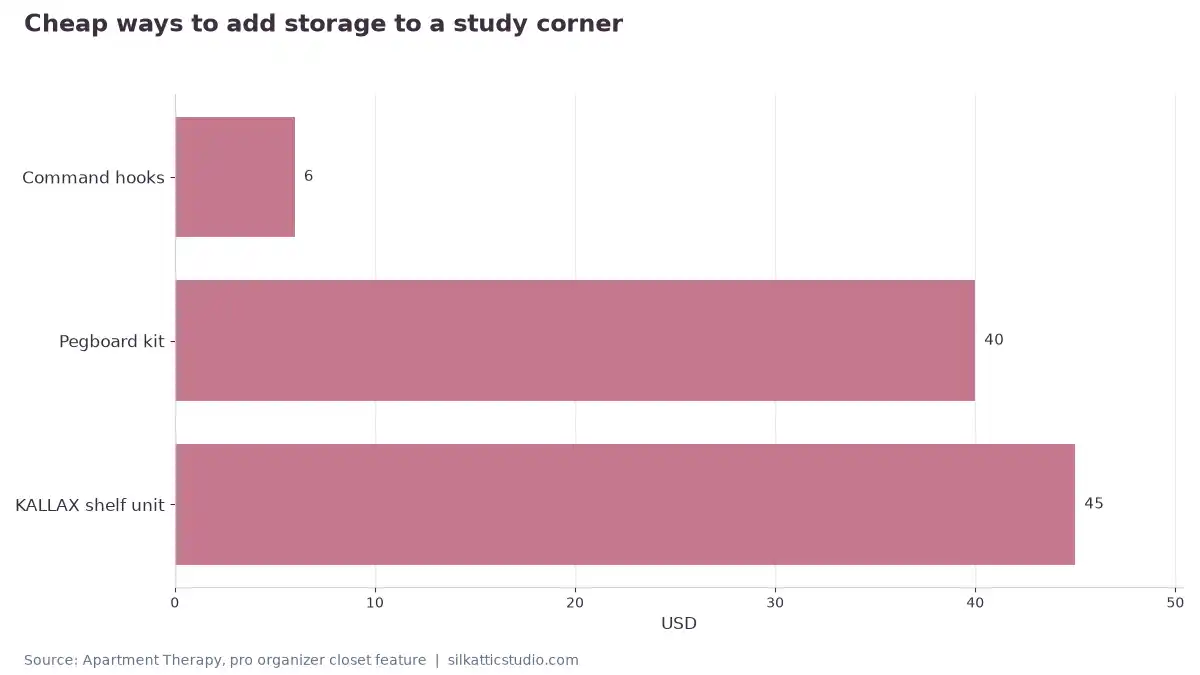
Cheap ways to add storage to a study corner -
Sort before you store.
Buying bins and shelves won’t help if everything still gets dumped in one pile. When a space becomes a catch-all, the categories begin to compete, so sorting possessions into clear categories and giving each one a designated home is the real fix, not just adding more containers. Pens in one spot, chargers in another, notebooks somewhere you can actually see them.
-
Build a two-minute shutdown ritual.
This is the step that protects your sleep, and it’s the one most people skip. Close the laptop, stack the books, push the chair in. Sleep guidance is consistent on this point: bedrooms work best when they’re reserved for rest. Using the bedroom only for sleep, with no TV, internet browsing or late-night messaging, helps keep that association clear. If your desk is in your bedroom, the ritual of physically closing it down each night does the same job that leaving the room would.
Your phone deserves the same treatment. Unplugging electrical devices an hour before bed matters because the blue light from screens inhibits the hormone, melatonin, that tells your body to wind down. If possible, don’t keep a phone, tablet or laptop charging right by the bed at night, since the light from the screen interferes with sleep. Move the charger to the opposite side of the room, or better, outside it.
A short stretch or walk between study blocks helps too. Regular exercise helps you sleep more soundly as well as improving your general health, with teenagers aiming for around 60 minutes of movement a day. You don’t need a gym session, five minutes pacing the hallway while you reread your notes counts.

Three setups, compared
| Setup | Best for | Typical footprint | Budget-friendly move |
|---|---|---|---|
| Corner desk | Rooms with one free wall and enough depth for a chair | Roughly 60 to 80cm wide | Check campus move-out sales or local swap groups at the end of term |
| Wall-mounted or floating desk | Very small or shared rooms where floor space is tight | Folds flat against the wall when not in use | Secondhand floating shelf plus a cheap folding stool |
| Closet nook | A spare or underused closet instead of clothes storage | Inside the closet footprint, door can close it away | An unused boiler or linen closet can become a mini office, giving a space to answer emails that isn’t your bedroom, built from basic boards and brackets |
If it doesn’t work
- You still end up on the bed with your laptop. Add a physical barrier, a curtain, a tall plant or even just turning the desk chair so it faces away from the mattress. Sightlines matter more than willpower here.
- The corner feels too dark to work in. Swap a ceiling bulb for a warm desk lamp angled onto the page, and if you can, move the desk closer to whatever window light you do have, even a sliver.
- Storage keeps creeping back onto the desk. Go back to sorting before adding more shelves. A smaller number of clearly labelled homes beats another empty bin.
- Your sleep is still rough even after the shutdown ritual. Give any new routine a few weeks before judging it, habits like this take time to stick. If poor sleep is affecting your mood or day-to-day life for more than a couple of weeks, it’s worth talking to a GP or someone you trust rather than troubleshooting alone.
Sources
- Sometimes Homemade: How to Create a Productive Study Space in a Small Bedroom
- Stanford College Puzzle: 5 Ways to Make Your Room the Perfect Study Space
- Tribesigns: How to Create a Study Area in a Small Bedroom, Dorm, or Apartment
- Joyce University: Top 10 Tips for Creating a Study Space at Home
- Apartment Therapy: I Asked a Pro Organizer How to Transform My Narrow Closet
- Apartment Therapy: 3 Space-Saving Entryway Storage Finds for Under $100
- Apartment Therapy: 8 Unexpected Ways to Repurpose Your Unused Closet Space
- NHS Wales: Sleep Hygiene Top Tips
- NHS Gloucestershire: Screen Sense